

Article 3 - Current Transformer Accuracy Classes: Choosing the Right Level of Precision
Current transformers (CTs) are used to measure or monitor electrical current. To ensure measurement reliability, they are classified according to their accuracy.
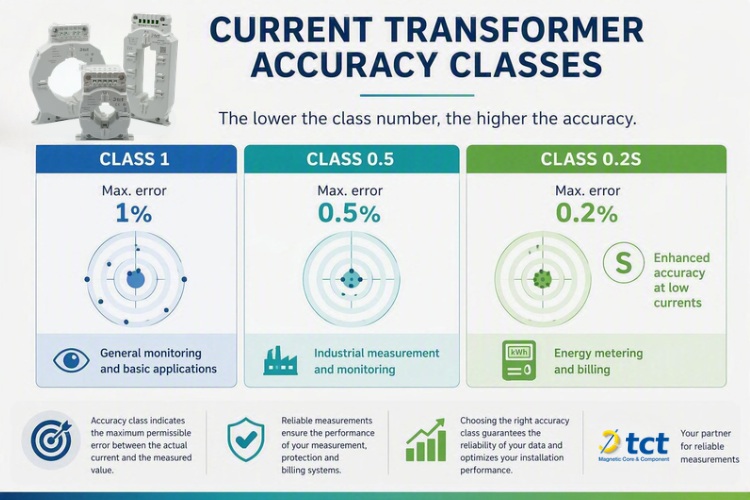
The accuracy class indicates the maximum permissible error between the actual current and the measured value. The lower the number, the higher the measurement accuracy.
For example:
Class 1: maximum error of 1% at rated current
Class 0.5: maximum error of 0.5% at rated current
Class 0.2: maximum error of 0.2% at rated current
Some classes also include the letter S, such as Class 0.2S or 0.5S. These classes offer enhanced accuracy, particularly at low current levels. They are especially suited to energy metering and billing applications, where measurement reliability is critical.
Technically, the accuracy class of a current transformer (CT) is defined by the IEC 61869 standards. Accuracy is assessed based on two main criteria:
1. Ratio Error (or Amplitude Error)
This represents the difference between the theoretical secondary current and the actual secondary current delivered by the transformer.
Example:
CT ratio: 100 A / 5 A
Actual primary current: 100 A
Theoretical secondary current: 5 A
Measured secondary current: 4.975 A
In this case, the CT exhibits a ratio error.
For a Class 0.5 CT, this error must not exceed ±0.5% at rated current under the conditions specified by the standard.
2. Phase Displacement Error
A CT does not only reproduce the magnitude of the current; it must also accurately reproduce its phase angle.
For this reason, the standard specifies a maximum allowable phase displacement between the primary and secondary currents.
For a Class 0.2S CT, TCT specifies, for example:
Maximum amplitude error: 0.2% at rated current
Maximum phase displacement: 10 minutes of arc (10') at rated current
Why can a CT be more or less accurate?
The accuracy class mainly depends on:
- The quality of the magnetic circuit (core)
- The transformer geometry
- The materials used
- The characteristics of the secondary winding
- The burden connected to the secondary side
At TCT, we design and manufacture current transformers that meet the requirements of measurement, metering, and protection applications.
Depending on your installation needs, we can offer various standard accuracy classes as well as custom accuracy classes, ensuring the performance level your application requires.
Want to Learn More? Need a Quote?
Feel free to contact us